
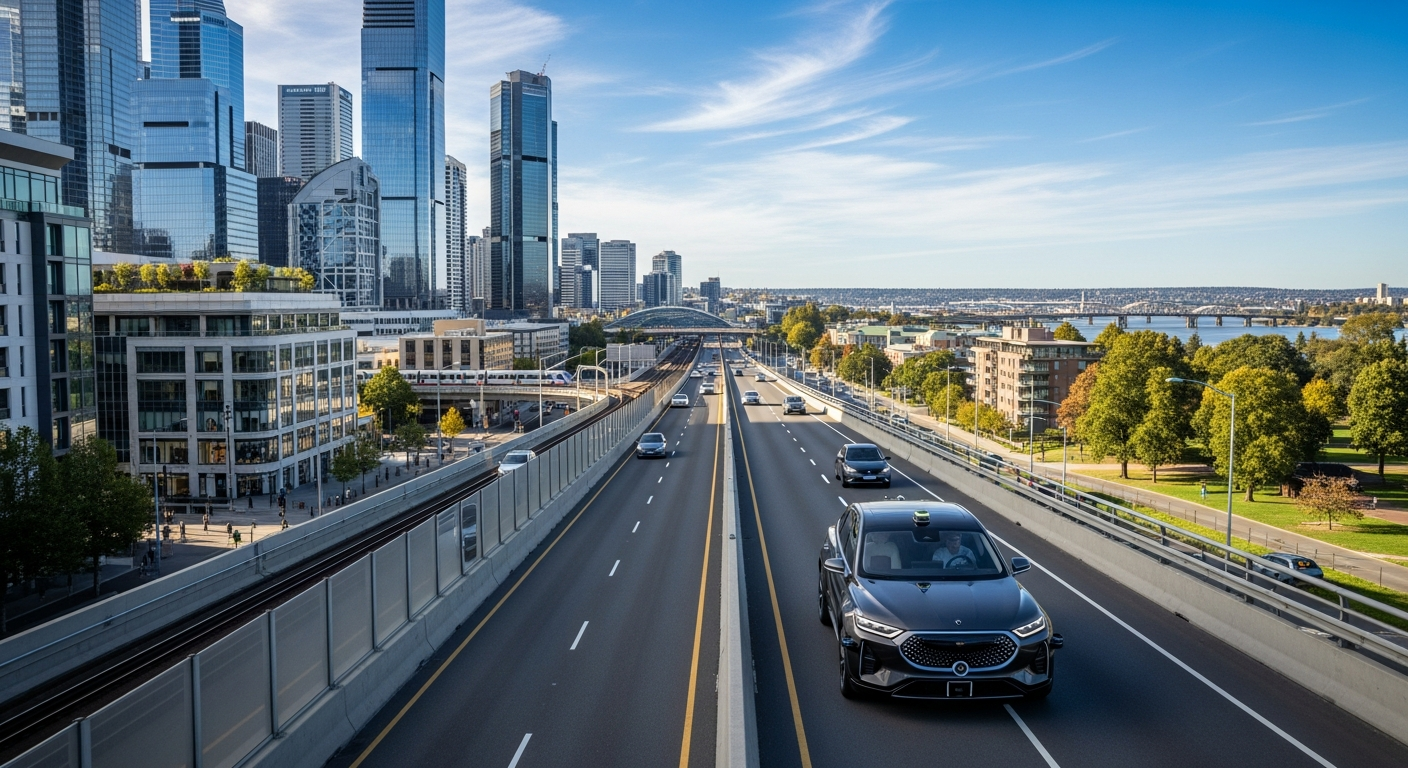
Self-driving cars are changing how we travel, promising a future where your car handles the driving. This guide will explain what these vehicles are and how they aim to keep you safe on the road.
1. What is a 'self-driving car' or 'autonomous vehicle'?
A self-driving car, also known as an autonomous vehicle (AV), is a car that can drive itself without a human needing to steer, accelerate, or brake. It uses advanced technology to understand its surroundings and navigate to a destination.
These cars are designed to perform all driving tasks, from following traffic rules to parking, on their own. The goal is to make travel safer, more efficient, and more accessible for everyone.
2. What are the different levels of autonomous driving?
There are six levels of autonomous driving, from Level 0 (no automation) to Level 5 (full automation). Most cars today offer Level 1 or 2 features, like adaptive cruise control or lane keeping assistance, which help the driver but still require full human attention.
Level 3 cars can drive themselves in certain conditions but need the driver ready to take over quickly. Level 4 vehicles can drive themselves fully in specific areas or conditions, while Level 5 cars can drive anywhere, anytime, without any human input needed.
3. How do self-driving cars 'see' the road?
Self-driving cars "see" the road using a combination of different sensors that act like their eyes and ears. These sensors collect vast amounts of data about the car's surroundings, including other vehicles, pedestrians, traffic lights, and road signs.
This data is then processed by the car's computer system to create a real-time, 3D map of the environment. This map allows the car to understand where it is, what's around it, and what actions it needs to take to drive safely.
Human Driver
- Uses eyes, ears, and touch
- Relies on experience and intuition
- Can be distracted or tired
- Reacts to unexpected events
Self-Driving Car
- Uses multiple sensors (cameras, radar, lidar)
- Relies on programmed rules and data
- Always alert and precise
- Processes vast data instantly
4. What kind of sensors do autonomous vehicles use?
Autonomous vehicles use several types of sensors. Cameras provide visual information, like traffic lights and lane markings. Radar sensors use radio waves to detect the distance and speed of other objects, even in bad weather.
Lidar sensors use lasers to create detailed 3D maps of the environment. Ultrasonic sensors are used for close-range detection, like parking. GPS provides location data, and powerful computers combine all this information to guide the car.
5. Are self-driving cars legal to use everywhere?
No, self-driving cars are not legal to use everywhere, especially at higher levels of automation. Laws and regulations vary significantly by country, state, and even city. Many places are still developing rules for these new technologies.
Currently, most self-driving cars operating on public roads are part of testing programs or are lower-level assisted driving systems. Always check local laws before using any autonomous features, as you remain responsible for the vehicle's operation.
6. How do self-driving cars make decisions?
Self-driving cars make decisions using complex computer programs and artificial intelligence (AI). They process all the sensor data to understand the current situation, predict what other road users might do, and then plan their own actions.
These systems follow programmed rules, traffic laws, and learned behaviors from millions of miles of driving data. They constantly evaluate risks and choose the safest and most efficient path, adjusting in real-time to changing conditions.
7. What are the main safety concerns with autonomous vehicles?
Safety concerns include how these cars handle unpredictable situations, like sudden obstacles or human error from other drivers. There are also worries about system failures, software glitches, and cybersecurity risks, where the car's systems could be hacked.
Ensuring the car's sensors work perfectly in all weather conditions and that the AI makes ethical decisions in unavoidable accident scenarios are also major challenges. Extensive testing and strict regulations are crucial to address these concerns.
Self-Driving Car Decision Flow
8. Can I take my hands off the wheel in a self-driving car?
It depends on the car's automation level. In Level 2 cars, which are common today, you must keep your hands on the wheel and eyes on the road, even if the car assists with steering or speed. These systems are helpers, not full drivers.
In Level 3 cars, you might be able to take your hands off the wheel in specific situations (like highway driving), but you must be ready to take over if the car asks. Only Level 4 and 5 cars allow you to truly disengage from driving tasks.
9. What is 'adaptive cruise control'?
Adaptive Cruise Control (ACC) is a common driver-assistance feature found in many modern cars. Unlike traditional cruise control, which just maintains a set speed, ACC uses sensors (usually radar) to automatically adjust your car's speed.
If the car in front of you slows down, ACC will slow your car down to maintain a safe following distance. When the road clears, it will speed back up to your set speed. It's a Level 1 automation feature, requiring constant driver supervision.
10. When can we expect fully self-driving cars to be common?
Fully self-driving cars (Level 5) are still some years away from being common for personal ownership. While Level 4 robotaxis are already operating in limited areas, widespread adoption faces challenges like technology perfection, cost, public acceptance, and legal frameworks.
Many experts predict that Level 4 vehicles will become more common in specific services (like delivery or ride-sharing) within the next decade. Level 5 personal cars, capable of driving anywhere, are likely further out, perhaps by the mid-2030s or later.