
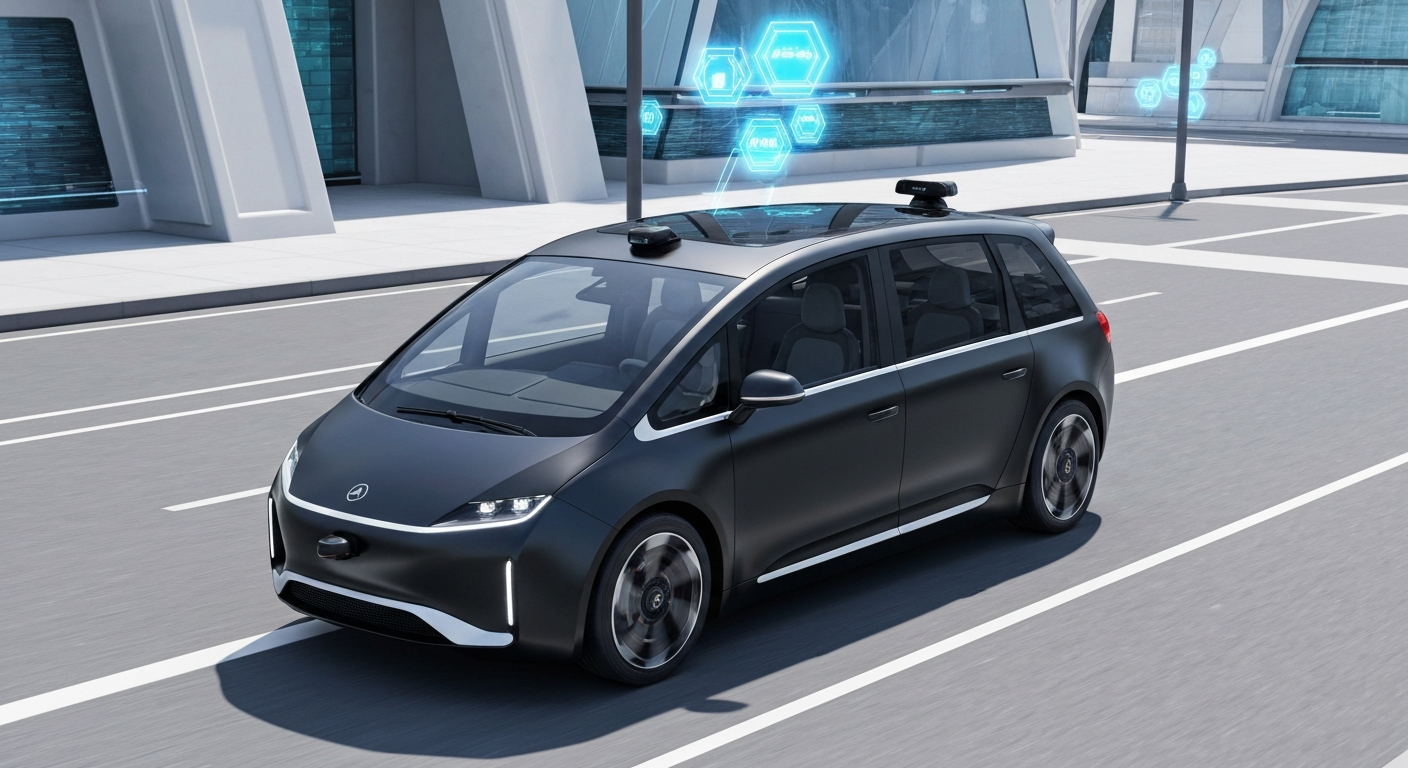
Self-driving cars are rapidly changing how we think about transportation, promising a future where our vehicles handle the driving. But what exactly does this technology mean for safety and our daily lives?
1. What does "self-driving car" really mean?
A "self-driving car," also known as an autonomous vehicle, is a car that can drive itself without human input. It uses technology to sense its surroundings, navigate, and make driving decisions.
These cars aim to perform all driving tasks, from starting and stopping to steering and changing lanes, allowing the human driver to be a passenger. However, most cars available today only offer advanced assistance, not full autonomy.
2. What are the different levels of autonomous driving?
There are six levels, from 0 to 5, defined by the Society of Automotive Engineers (SAE). Level 0 means no automation, while Level 1 (like cruise control) and Level 2 (like adaptive cruise control with lane keeping) offer driver assistance, requiring human supervision.
Level 3 cars can drive themselves in specific conditions but need the driver ready to take over. Level 4 vehicles can handle most driving situations within a defined area, and Level 5 cars can drive anywhere, anytime, without any human interaction.
3. Is fully autonomous driving legal today?
In 2026, fully autonomous driving (Level 5) is not yet legal for public use in most places. While some companies are testing Level 4 vehicles in limited areas, these are typically under strict regulations and often with safety drivers.
Laws and regulations are still catching up with the technology. Most cars you can buy today offer Level 2 features, providing assistance but always requiring the driver to be alert and in control.
Human Driver
- Can adapt to unique, unpredictable situations
- Understands social cues (e.g., eye contact)
- Can make ethical judgments in emergencies
Self-Driving Car
- No distraction, fatigue, or impairment
- 360-degree, constant awareness via sensors
- Faster reaction times in predictable scenarios
4. How do self-driving cars "see" the road?
Self-driving cars "see" the road using a combination of advanced sensors and powerful computers. These sensors collect vast amounts of data about the car's surroundings, creating a detailed, real-time map.
The car's computer then processes this data, identifying other vehicles, pedestrians, traffic signs, lane markings, and potential hazards. It uses this information to understand the driving environment and plan its next moves.
5. What sensors do autonomous vehicles use?
Autonomous vehicles use several types of sensors. Cameras act like eyes, detecting colors, signs, and lane lines. Radar sensors use radio waves to measure distance and speed of objects, even in bad weather.
Lidar (Light Detection and Ranging) uses laser pulses to create a precise 3D map of the surroundings. Ultrasonic sensors use sound waves for short-range detection, helpful for parking. These sensors work together to give the car a complete picture.
6. Are self-driving cars safer than human drivers?
The goal of self-driving technology is to reduce accidents caused by human error, such as distraction or fatigue. While still in development, early data suggests autonomous vehicles can be safer in certain controlled environments.
However, they still face challenges in highly complex or unpredictable situations. As the technology improves and more testing occurs, the hope is that self-driving cars will significantly reduce road fatalities over time.
7. What are the ethical concerns of autonomous driving?
One major concern is how self-driving cars should make decisions in unavoidable accident scenarios. For example, if a crash is imminent, should the car prioritize the occupants' safety or minimize harm to pedestrians?
Other concerns include data privacy (as cars collect much information), job displacement for professional drivers, and determining legal responsibility when an autonomous vehicle is involved in an accident. These complex issues require careful consideration.
How a Self-Driving Car Makes Decisions
8. What is adaptive cruise control?
Adaptive cruise control (ACC) is a Level 1 or 2 driver assistance feature. Unlike traditional cruise control, ACC automatically adjusts your car's speed to maintain a safe following distance from the vehicle ahead.
If the car in front slows down, your car will slow down too. If the path clears, it will accelerate back to your set speed. It helps reduce driver fatigue on highways but still requires the driver's attention.
9. How does lane-keeping assist work?
Lane-keeping assist (LKA) is another common driver assistance feature. It uses cameras to detect lane markings on the road. If your car starts to drift out of its lane without a turn signal, LKA will gently steer it back.
Some systems also offer lane centering, which actively works to keep the car in the middle of the lane. LKA is designed to prevent unintentional lane departures and improve safety, but the driver must remain engaged.
10. What challenges remain for self-driving cars?
Many challenges persist before full autonomy is widespread. These include handling extreme weather conditions like heavy snow or fog, which can obscure sensors. Navigating complex urban environments with unpredictable pedestrians and cyclists is also difficult.
Public trust and acceptance are crucial, requiring robust safety records and clear regulations. The technology also needs to be affordable and reliable for mass adoption. Continued research and testing are vital to overcome these hurdles.